
This Month in AI
- NYC establishes law restricting certain chatbot features for minors
- Virginia signs directive creating plans meant to protect against cyber threats presented by AI
- Utah signs executive order requiring agencies to “void” AI that don’t comply with the principles Utah’s Pro-Human AI Initiative
Our Work Over the Past Month
- We are continuing to field applications for Deputy Writer and Deputy Social Media Editor! Descriptions of both positions can be found on our social media and our application form. If you wish to apply, use the link below:
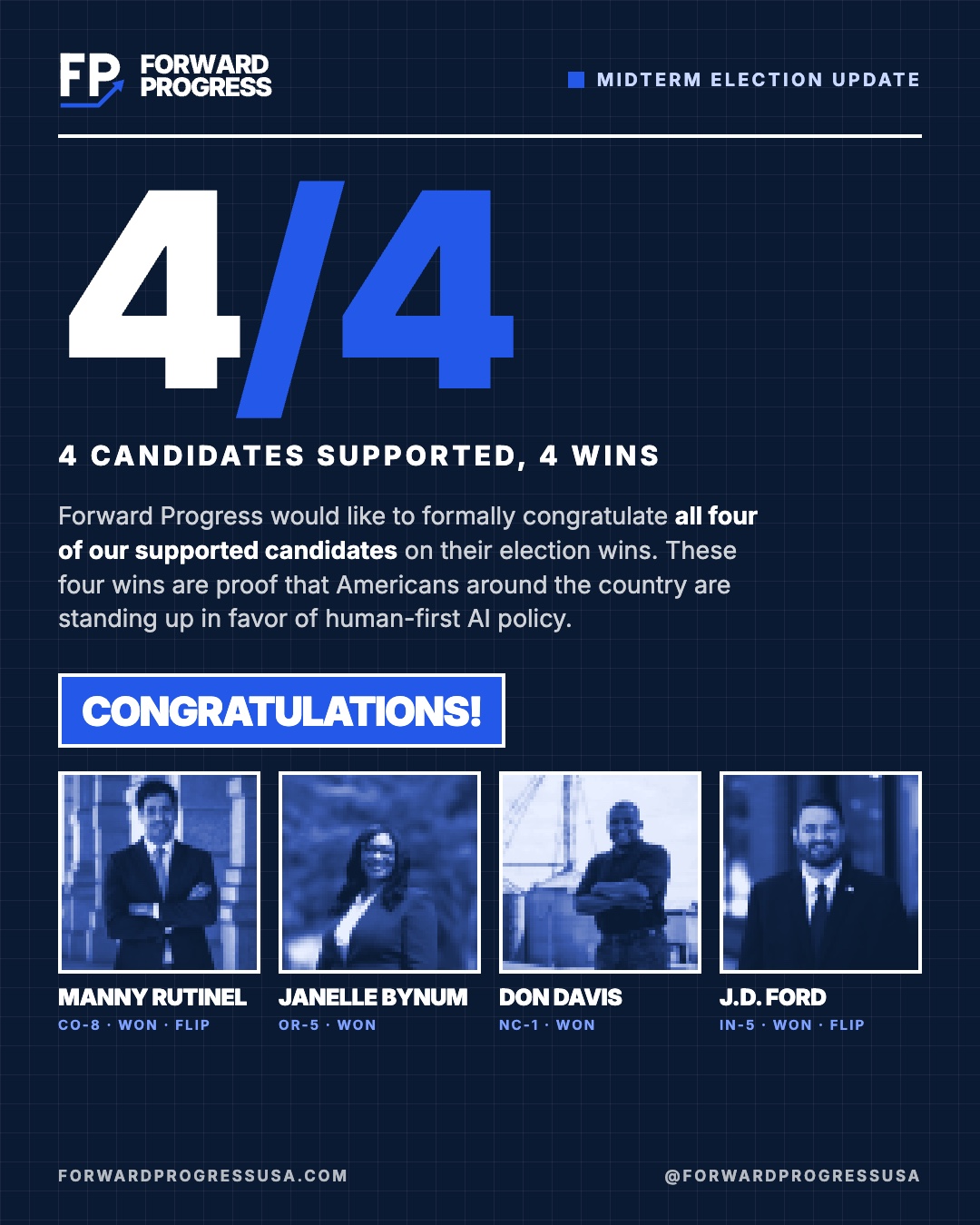
Application form - We officially reached 35,000+ voter contacts through 8 phone banks!
*We’ve phone banked for 4 endorsed candidates: Manny Rutinel, Janelle Bynum, Don Davis, and JD Ford. - Lastly and most importantly, all 4 of our endorsed candidates (listed above) won their competitive races on Tuesday!
AI Policy Decision of the Month
National Security Presidential Memorandum 11
Summary: The National Security Presidential Memorandum (NSPM) 11 was issued by President Trump on June 5, 2026. The memorandum aims to further accelerate the AI adoption by the US military and intelligence agencies. The memorandum also directs updated AI acquisition, use, and management policies while also attempting to force AI companies to comply with Trump administration policies. On top of this, the memorandum orders the “termination” of government contracts with AI companies that wish to limit how the government uses their products. This decision comes after an executive order on June 2, 2026 as the current administration continues to assert its AI policy through executive actions.
- Government or institution responsible
- Executive Branch (The President)
- Country/state/locality
- United States
- Date enacted, issued, or decided
- June 5, 2026
Arguments in favor
The memorandum would remove regulatory restrictions that slow the advancement and adoption of AI in the military, allowing the US to catch up with other foreign rivals who already use advanced technologies in their militaries. Other supporters argue that the development of AI is a competition of speed, and the one who can do it the fastest will retain or possibly even control their global security and economic advantage. This memorandum allows the US to compete in that race, possibly giving them the ability they need to win.
Arguments or concerns against
Critics argue that the memorandum gives too much power to AI especially in the military, possibly removing the “human” factor when making important decisions. Furthermore, the memorandum removes specific safety frameworks which protect human rights and civil liberties. Removing these guardrails could lead to negative consequences in the future as AI is allowed to grow with little regulations and risk assessment. Furthermore, the ability to terminate contracts with different AI companies may make it seem like the government is cherry picking the organizations that it would like to work with, leaving others behind. All of this partnered with the current administration’s lack of transparency with other matters relating to this such as seen through the FOIA lawsuit make critics feel uneasy about giving the government this much power.
Why it matters to young people
AI is constantly being added into people’s daily lives. With the way things are looking right now, AI is the future. However, it is also important that AI isn’t the only future. This memorandum introduces AI into the military, possibly a new type of warfare characterized by autonomous intelligence and artificial decisions. It is important that young people make their voices heard, ensuring that AI is used for good in the future, and that people now don’t make decisions about a future that the next generation has to live.
Connection to FPUSA’s principles
FPUSA understands that a future with AI is inevitable. AI has the ability to do so much good in the world and already is. However, FPUSA also acknowledges that the opposite is also just as true. With this in mind, FPUSA advocates for the use of AI for the betterment of society and the application of “common sense laws” with the topic of AI. These common sense laws would ensure that AI is under proper regulation and minimizes the harm that it could cause. In relation to this policy, FPUSA believes that this memorandum should be altered as it gives AI and the government too much power with very little limits or regulation. Instead, a plan that promotes sustainable and safe AI development which is not involved with the military should be adopted and enacted.
Links to 2 Credible Sources
Midterm Madness: The Presence of AI in Elections
In its early stages, AI video creation seemed to be more of a hobby than anything else. Videos of people with feet for hands, cats singing, and many other obscure images were easily and quickly pointed out to be AI.
However, with the development of better AI technologies, it’s becoming harder to distinguish what is real from what is fake. Today, AI has turned into a useful asset for not only content creators, but also businesses and even political campaigns. This election season alone, there has been a noticeable increase in the use of AI for political messaging via social media and other media networks.
A recent study by the New York Times found that political action groups spent over “$137 million” on AI-generated or AI-influenced ads. What’s arguably worse is the fact that a similar study by the Wesleyan Media Project found that, “Sixty-nine percent of the ads and 78 percent of the spending did not have a disclaimer that disclosed the use of AI tools.” The same study also states, “We have now identified a minimum of 220 political ads generated or enhanced through the use of AI.”
One example of these ads can be seen in the current race for New York Governor. On May 15, 2026 current republican candidate Bruce Blakeman produced a deepfake video featuring New York City Mayor Zohran Mamdani as well as current New York Governor and Democrat Kathy Hochul. The video is modeled in the animation style of the TV show South Park by Trey Parker and Matt Stone and includes several of the main characters complaining about Hochul’s policies while the governor and Mamdani furthered the characters’ dismay through their answers to questions. When asked about the ad Blakeman defended it by saying it was “satire” and “humour” which are not new to American politics. However, following the release of the ad, the campaign was forced to include that the video was made by AI in order to comply with New York state law.
While this ad was seen as a more obvious use of AI since it was in cartoon form, newer, more realistic ads have come out within the past few months. Newer AI ads can also be seen in Michigan’s Senate race between Abdul El-Sayed and Mike Rogers as well as in Texas’s Senate race between James Talarico and Ken Paxton.
These more realistic ads are arguably worse for voters and their knowledge and safety. Deepfake AI videos allow candidates to put words into the mouths of their opponents that aren’t true, or even create situations that never happened. The videos, partnered with different stereotypes and other political advertisements, leads to a further increase in tensions as well as possible harassment between different parties or groups. Adding on, the newness of a situation like this one means that not every state has the necessary regulations or policies put in place to help regulate these AI advertisements, or even help distinguish what’s actually real. Thus, it’s up to voters to discern whether an advertisement is true or fake.
The numbers don’t necessarily help either. According to a research poll by Scripps News, “More than four-in-ten registered voters say they’ve seen something they thought was real in a political ad, only to later find it was AI-generated. Another 30% said they saw something they weren’t sure was real or AI.” All of these statistics and claims then point to one question: what’s the solution to all of this?
The US government and states should pass rules and regulations on the use of AI within political campaigns. Somewhat surprisingly, this is one of the topics and solutions that is pretty much agreed upon by both parties. The same poll from Scripps News found that, “77% of Democrats and 79% of Republicans” say that there should be rules around how technology like AI is used. Another survey by Pew Research Center found that during the time of the 2024 presidential election, “A 57% majority of U.S. adults – including nearly identical shares of Republicans and Democrats – say they are extremely or very concerned that people or organizations seeking to influence the election will use AI to create and distribute fake or misleading information about the candidates and campaigns.” Rules and regulations around these types of ads would prevent the spread of fake or misleading information, helping inform voters and giving them the confidence they need to vote for the candidate they support.
AI is not something that should be banned or shunned away from because of its newness and possibilities. Rather, AI is a new technology that, like any other technologies or tools, should be given regulations and rules to ensure the safety of people and the environment. As of now, it is up to us to make sure that these things happen and allow for AI to be a tool that leads us to a better future.
The Reality Behind Data Centers
AI data centers are often perceived as the spawn of evil corporations seeking to destroy local communities, habitats, water supplies, and local power grids. While there is no denying the actions of some AI companies end up creating more harm than good, the construction of data centers is a much more nuanced issue and needs to be treated as such.
To help our organization cut through the noise, lead writer Alex Goldfine talked with Kyle Younker. Younker serves as senior editor at New Project Media, a publication focused on data centers, specializing in how they’re powered.
Younker argued that there are two main criticisms that often come up when debating data center construction: the strain they put on local grids and their water consumption.
While it varies from center to center, data centers–especially new ones and those under construction–often rely on external power sources, primarily natural gas. This is because natural gas is both cheap to acquire and easy to build infrastructure for when compared to alternative power sources. These data centers, although questions can be raised about the effects of natural gas on pollution, avoid much of the strain on local power grids because they pump in this gas at extremely low prices from the Permian Basin in Texas.
The second and arguably larger criticism of data centers is their water consumption. While it is true most older data centers use vast amounts of water to cool the hardware, new data center designs include plans that require “very little water.” For example, many run on a closed loop system (often containing just water and a “mild chemical”) that only requires refilling every “5-7 years.” The advent of the water efficiency of these new data centers is tremendously beneficial. Almost all of the new and in-development data centers will be cleaner, consume less water, and strain the grid less than they did even a few years ago.
Downsides such as noise pollution, the use of greenhouse gases, along with other criticisms about data centers still exist. However, as AI data centers continue to put less strain on local grids and become more water efficient, the debate should focus on whether each project meets clear standards for emissions, water use, noise, and community consent, rather than treating all data centers as equally harmful.
Ultimately, Forward Progress believes that as long as these data centers are used and constructed ethically, efficiently, and cleanly, their construction should be permitted as long as local communities allow it.
Robot Teachers
We’ve all heard the hype lately: “AI is the future of education!” Tech companies promise us personalized learning plans and instant grading. But we need to think for a second. Can a computer program truly look at a struggling student, notice they’re having a bad day, and offer the kind of comfort and motivation that only a human mentor can?
The answer is no. And that’s okay.
AI is a powerful tool, like a calculator for words, but it doesn’t have empathy. It doesn’t care if you succeed or fail, it just processes 0s and 1s. A human teacher sees the whole picture. They know when you’re bored, when you’re confused, or when you’re hiding talent because you’re afraid to try. That connection is the heart of education.
If we let algorithms replace teachers, we aren’t saving money, but losing the human element that makes school worth going to. AI should be given to teachers to help them complete the busy work: grading papers and planning lessons faster. This will free teachers up to do what they do best: mentor us.
Here at Forward Progress, we believe that AI shouldn’t primarily be used as a cheaper substitute to every issue; but should instead be used to support humans in their roles.
Think About It
Who should control AI?
Artificial intelligence is changing elections, education, and the infrastructure that powers our communities. But who should decide how this technology is used?
Imagine you could establish one national AI policy. Which would you prioritize?
- A. Require clear labels on AI-generated political advertisements.
- B. Establish national standards for AI use in schools.
- C. Require stronger environmental standards for AI data centers.
- D. Allow companies to innovate freely, with limited government restrictions
Each of these options involve trade-offs between innovation, accountability, individual freedom, and public safety.
Which policy would you choose, and what is one drawback or unintended consequence your choice may create?